
Pulmonary arterial hypertension: a case of severe exertional hypoxaemia and reduced diffusing capacity

Pulmonary arterial hypertension (PAH) is an uncommon but life-threatening cause of exertional dyspnoea. Diagnosis is frequently delayed because early symptoms are nonspecific and findings of routine investigations may be normal. GPs play a critical role in recognising warning signs and initiating timely referral to a specialist. This case emphasises practical diagnostic clues to pulmonary vascular disease, highlights the value of lung diffusion testing in patients with unexplained breathlessness and summarises contemporary approaches to the diagnosis and management of PAH relevant to primary care.
- Unexplained exertional desaturation is a red flag requiring investigation.
- Normal spirometry findings with markedly reduced diffusing capacity of the lungs for carbon monoxide should prompt referral of patients for pulmonary vascular disease assessment.
- Most cases of pulmonary hypertension encountered in primary care are secondary to cardiac or lung disease rather than pulmonary arterial hypertension (PAH).
- Echocardiography is a screening tool; right heart catheterisation is required for a definitive diagnosis of PAH.
- Early specialist referral improves outcomes in patients with PAH.
Pulmonary hypertension (PH) is defined haemodynamically as a mean pulmonary arterial pressure exceeding 20 mmHg at rest on right heart catheterisation.1 Pulmonary arterial hypertension (PAH), classified as WHO group 1 PH, represents a precapillary disorder characterised by elevated pulmonary vascular resistance with normal pulmonary capillary wedge pressure due to a disease of small pulmonary arteries.
It is important for GPs to recognise that although PH is not rare, PAH (group 1) is uncommon. In primary care, most patients with echocardiographic findings suggestive of PH will have secondary causes: left heart disease (group 2) or lung disease and hypoxia (group 3). PAH-specific vasodilator therapy is not indicated and may be harmful in these groups, underscoring the importance of accurate classification through specialist referral and right heart catheterisation.2,3 A simplified clinical classification of PH is presented in Box 1, helping to contextualise PAH among more common causes.1,4
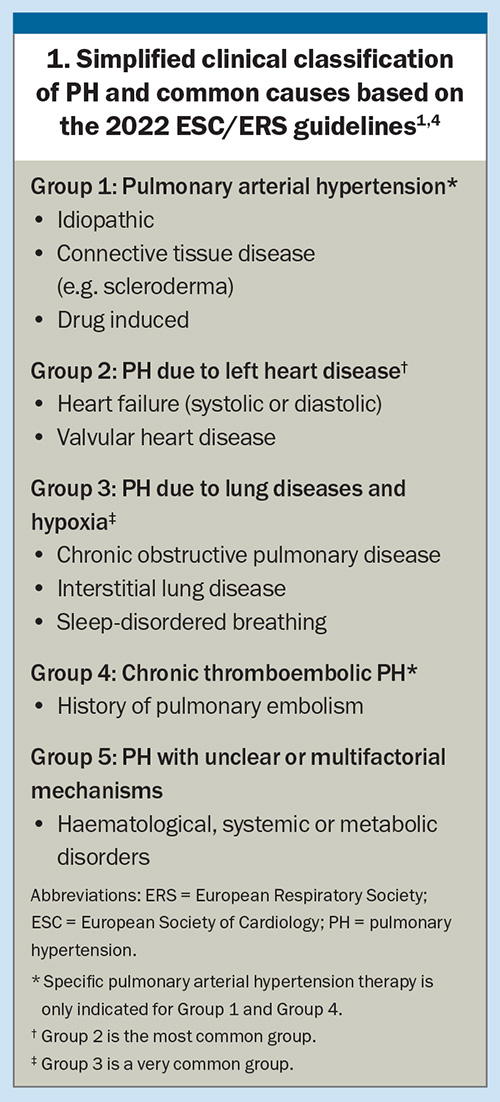
Although PAH is rare, GPs frequently assess patients with breathlessness. Early identification of clinical red flags is essential to reduce diagnostic delay. These warning features include:
- exertional desaturation
- unexplained syncope or presyncope
- failure to respond to asthma or chronic obstructive pulmonary disease therapy
- borderline resting hypoxaemia
- markedly reduced diffusing capacity of the lungs for carbon monoxide (DLCO) despite normal spirometry.5
The following case illustrates how disproportionate exercise-induced hypoxaemia and isolated DLCO reduction revealed severe precapillary pulmonary hypertension.
Case scenario
Presentation
A 61-year-old woman was referred for an evaluation of progressive exertional breathlessness and intermittent presyncope over several months. Her exercise tolerance had declined significantly, consistent with WHO functional class III symptoms (i.e. marked limitation of physical activity) at the time of referral. She denied a chronic cough, wheeze or sputum production and reported no orthopnoea or paroxysmal nocturnal dyspnoea.
She reported no symptoms suggestive of connective tissue disease, no exposure to appetite suppressants or other recognised drug causes and no family history of PH. A remote venous thromboembolic event was documented, without evidence of recurrence. Her occupational and environmental exposure history was unremarkable.
On examination, she appeared comfortable at rest. Her resting oxygen saturation on room air was within the normal range. Her blood pressure and heart rate were stable. No peripheral oedema or raised jugular venous pressure was present, and there were no clinical features of significant parenchymal lung disease. Cardiovascular examination did not demonstrate classical findings of PH.
Investigations
Pulmonary function testing
The spirometry and lung volumes were normal without evidence of obstruction or restriction. In contrast, her DLCO was severely reduced to about 30% predicted. The combination of normal spirometry with a markedly reduced DLCO suggested pulmonary vascular pathology rather than primary airway or parenchymal disease.6
Exercise testing
Six-minute walk testing demonstrated a resting oxygen saturation of 91% with desaturation to 74% during exertion and a walking distance of 285 metres (about 59% predicted). The supplemental oxygen level improved but did not completely correct exercise-induced hypoxaemia.
Imaging and echocardiography
Chest imaging did not demonstrate interstitial lung disease or emphysema sufficient to explain the hypoxaemia. CT pulmonary angiography and ventilation–perfusion scanning excluded chronic thromboembolic disease.
Transthoracic echocardiography demonstrated preserved left ventricular systolic function and no significant valvular disease. The right ventricular size and function appeared preserved. A notable finding was the inability to estimate reliably the right ventricular systolic pressure due to an insufficient tricuspid regurgitation Doppler signal – a recognised limitation of echocardiography. This case illustrates that a ‘normal’ or nondiagnostic echocardiogram does not exclude significant PAH in a highly symptomatic patient.
A bubble contrast study excluded intracardiac shunting.
Right heart catheterisation
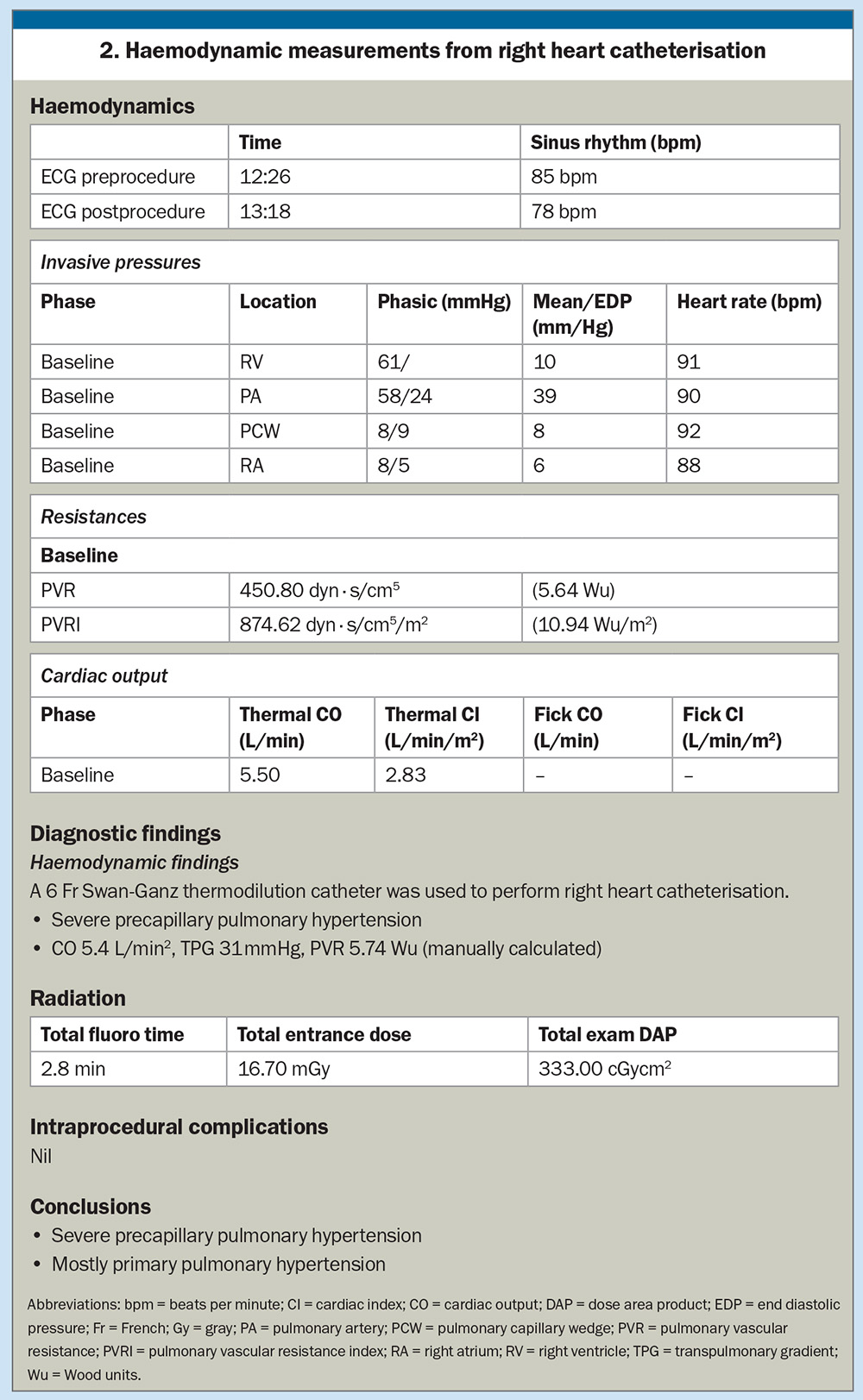
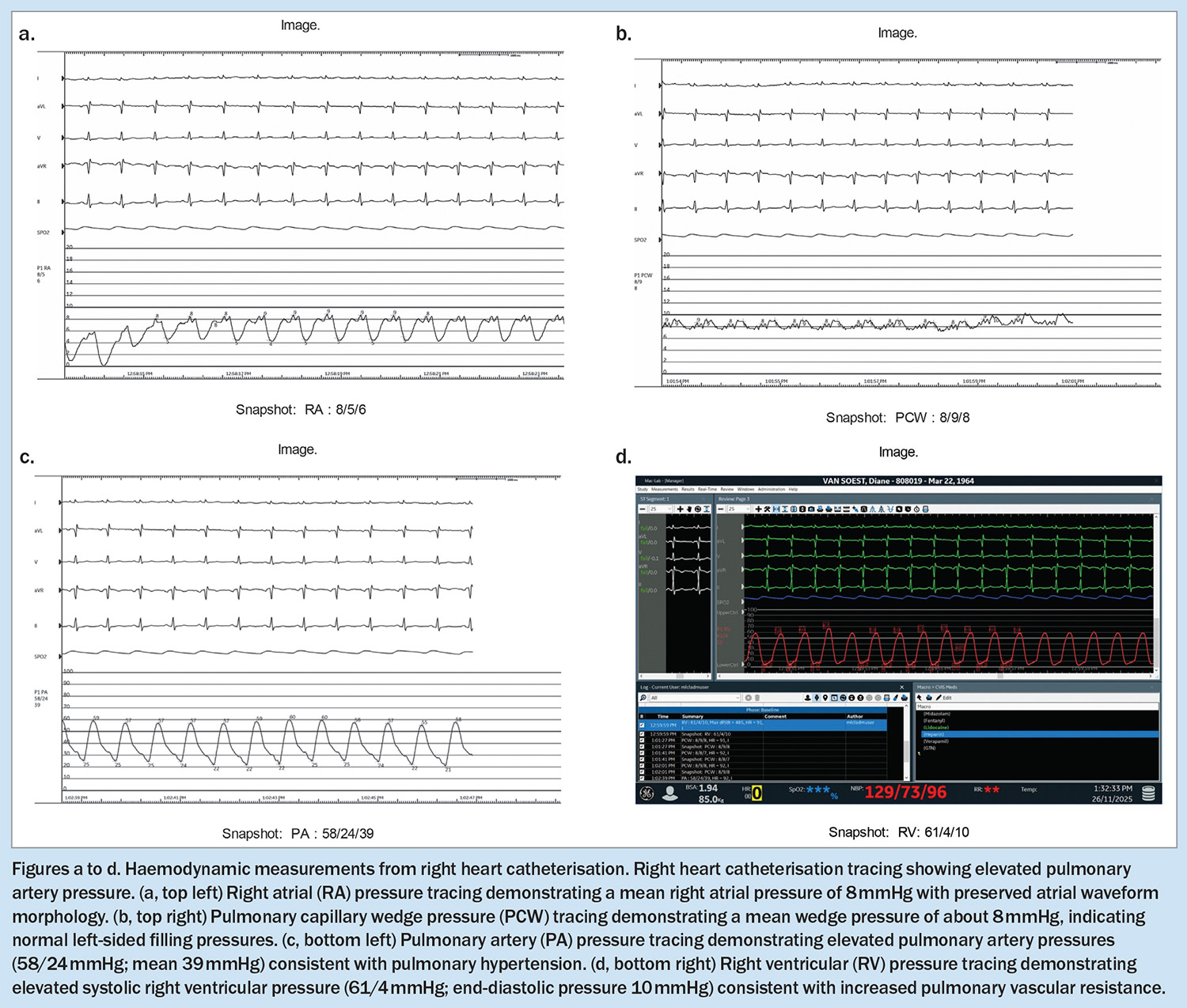
Right heart catheterisation confirmed the presence of precapillary PH (Box 2; Figures a to d). Although the pulmonary artery pressure was elevated, the right atrial pressure and cardiac index remained preserved, indicating that the haemodynamic risk markers were not markedly abnormal. This highlights that the symptoms, DLCO reduction and exercise hypoxaemia may appear disproportionate to the resting haemodynamics.
Differential diagnosis
Group 2 PH due to left heart disease was excluded based on the normal wedge pressure and echocardiographic findings. Group 3 disease related to lung pathology was unlikely given the normal spirometry and absence of significant parenchymal abnormalities. Group 4 chronic thromboembolic disease was excluded based on the findings of normal ventilation–perfusion imaging.
Autoimmune screening showed only low-titre antinuclear antibody positivity without clinical connective tissue disease. The results of screening for portal hypertension, congenital heart disease, HIV infection and toxin exposure were negative.
Pulmonary veno-occlusive disease remained a consideration given the marked DLCO reduction and exercise desaturation; however, imaging findings lacked supportive features, and pulmonary oedema did not occur following therapy initiation. Ongoing surveillance continued. A working diagnosis of idiopathic WHO group 1 PAH was made.
Management
Management focused on symptom relief, risk reduction and disease-modifying therapy. Ambulatory oxygen supplementation was commenced to address exertional hypoxaemia.
Following specialist PH review, initial dual oral therapy with macitentan (an endothelin receptor antagonist) and tadalafil (a phosphodiesterase-5 inhibitor) was initiated in accordance with contemporary risk-based treatment algorithms.7 It is important to note that prescription of these PAH-specific therapies requires assessment by a physician with expertise in PH and, in Australia, approval under the PBS; initiation is not undertaken in primary care. Although pregnancy counselling and contraception are mandatory components of care when prescribing endothelin receptor antagonists due to teratogenic effects, this was less relevant for our postmenopausal patient.
Supervised pulmonary rehabilitation and exercise training were also initiated.
Outcome and follow up
At follow up, the patient reported improved exercise tolerance and reduced breathlessness in daily activities. No further presyncope occurred and there were no signs of right heart failure. Ongoing structured risk assessment and therapy adjustment were planned.
Commentary
This case illustrates several important principles relevant to general practice. Pulmonary vascular disease frequently presents with nonspecific breathlessness while routine investigations may appear normal. Spirometry alone may therefore be misleading. A markedly reduced DLCO in this context is a critical warning sign and should prompt referral of the patient to a specialist.6
Exercise-induced desaturation without significant parenchymal lung disease is another important red flag. Any unexplained fall in oxygen saturation below 90%, or drop greater than 5% with exertion, warrants further evaluation.5
Echocardiography is an important screening tool but may underestimate PH when tricuspid regurgitation signals are insufficient. As demonstrated in this case, the absence of an estimable right ventricular systolic pressure does not exclude significant PAH. Definitive diagnosis requires right heart catheterisation.3
Modern PAH management relies on comprehensive risk stratification rather than pulmonary artery pressure alone. Functional class, exercise capacity, cardiac index, right atrial pressure, biomarkers and imaging findings guide therapy escalation and prognosis.7
Although PAH remains a serious, progressive condition, modern treatment strategies have significantly improved survival and quality of life. Early recognition and referral of patients are therefore critical to achieving better long-term outcomes.8
Finally, the diagnosis of a chronic, life-limiting disease like PAH carries a substantial psychological burden, with anxiety and depressive symptoms commonly reported. Comprehensive care must therefore integrate pulmonary rehabilitation, patient education and psychosocial support, areas where the ongoing involvement of the GP is invaluable.9
Conclusion
Severe precapillary PAH may present with preserved resting oxygenation and minimal routine imaging abnormalities. A markedly reduced DLCO with otherwise normal spirometry and disproportionate exertional hypoxaemia should prompt evaluation for pulmonary vascular disease. GPs play a central role in recognising these warning features and facilitating early referral of the patient to a specialist. Right heart catheterisation remains essential for diagnosis and treatment planning. Early specialist management improves patient outcomes. CT
COMPETING INTERESTS: None.
References
1. Humbert M, Kovacs G, Hoeper MM, et al.; ESC/ERS Scientific Document Group. 2022 ESC/ERS guidelines for the diagnosis and treatment of pulmonary hypertension. Eur Heart J 2022; 43: 3618-3731.
2. Hoeper MM, Lee SH, Voswinckel R, et al. Complications of right heart catheterization procedures in patients with pulmonary hypertension in experienced centers. J Am Coll Cardiol 2006; 48: 2546-2552.
3. Galiè N, Humbert M, Vachiery J-L, et al. 2015 ESC/ERS guidelines for the diagnosis and treatment of pulmonary hypertension. Eur Heart J 2015; 46: 903-975.
4. Simonneau G, Montani D, Celermajer DS, et al. Haemodynamic definitions and updated clinical classification of pulmonary hypertension. Eur Respir J 2019; 53: 1801913.
5. Frost A, Badesch D, Gibbs JSR, et al. Diagnosis of pulmonary hypertension. Eur Respir J 2019; 53: 1801904.
6. Trip P, Kind T, van de Veerdonk M, et al. Accurate assessment of load-independent right ventricular systolic function in patients with pulmonary hypertension. J Heart Lung Transplant 2013; 32: 50-55.
7. Galiè N, Barberà JA, Frost AE, et al.; AMBITION Investigators. Initial use of ambrisentan plus tadalafil in pulmonary arterial hypertension. N Engl J Med 2015; 373: 834-844.
8. Benza RL, Miller DP, Gomberg-Maitland M, et al. Predicting survival in pulmonary arterial hypertension: insights from the Registry to Evaluate Early and Long-Term Pulmonary Arterial Hypertension Disease Management (REVEAL). Circulation 2010; 122: 164-172.
9. Guillevin L, Armstrong I, Aldrighetti R, et al. Understanding the impact of pulmonary arterial hypertension on patients’ and carers’ lives. Eur Respir Rev 2013; 22: 535-542.
Single article purchases are temporarily unavailable due to site maintenance.
If you would like to purchase an article during this time, please email us at [email protected] with the article details and we'll assist you directly. We'll also let you know when online purchasing is available again.
Thank you for your patience and understanding.