
Microvascular angina: ‘big trouble from tiny vessels’

Patients with typical angina symptoms but normal coronary arteries on angiography often present a diagnostic challenge. One possible explanation is that these patients have microvascular angina, where myocardial ischaemia results from abnormalities of the tiny coronary microvessels rather than stenoses of the large coronary arteries. Although these microvessels account for over 95% of the coronary circulation, they cannot be imaged clinically so their role in angina is often overlooked.
- Microvascular angina is caused by a malfunction of the heart microscopic vessels.
- The ‘big trouble’ from these tiny vessels is that they cannot be imaged, making microvascular angina challenging to diagnose and often unrecognised.
- Microvascular angina is more common in women than men and an important consideration in women’s heart disease.
- Microvascular angina typically manifests as angina with angiographically normal or near-normal coronary arteries.
- A definitive diagnosis of microvascular angina requires specialised functional coronary angiography with measurement of coronary blood flow.
- Limited effective therapies are available for microvascular angina. More clinical trials are required to explore new therapies.
Angina is the clinical manifestation of myocardial ischaemia, which may arise from abnormalities in the large coronary arteries (0.5 to 5.0 mm in diameter) or coronary microvessels (<0.5 mm in diameter), or both. Coronary artery abnormalities (atherosclerotic coronary artery disease [CAD]) are readily imaged on noninvasive or invasive coronary angiography and can be treated with evidence-based medical therapy and/or revascularisation procedures (coronary stenting and/or coronary artery bypass surgery). In contrast, the coronary microvessels cannot be clinically imaged, they are not amenable to revascularisation therapies and there are limited evidence-based effective medical therapies that target these vessels. Thus, patients who experience angina due to coronary microvascular dysfunction (CMD) are often misdiagnosed and the angina may be difficult to treat – i.e. ‘big trouble from tiny vessels’.
Focusing only on obstruction: a common diagnostic bias
Although CMD may occur in patients with or without atherosclerotic CAD, the latter case is especially problematic, with patients often misdiagnosed as having ‘noncardiac chest pain’ in the absence of obstructive atherosclerotic CAD.1 In a recently published Australian cohort study, one-third of patients referred by cardiologists for elective invasive coronary angiography to investigate angina symptoms did not have obstructive CAD to account for their presentation.2 Despite most of these patients having a positive noninvasive test for myocardial ischaemia, only 22% were discharged with a cardiac diagnosis. Furthermore, only 6% underwent further investigation to evaluate a potential cardiac cause for their angina symptoms.2
ANOCA: a necessary diagnosis
To avoid this misdiagnosis, patients with typical angina symptoms in the absence of obstructive CAD on coronary angiography should be diagnosed as having ‘angina with nonobstructive coronary arteries (ANOCA)’. This general term recognises that these patients have cardiac symptoms needing further cardiac assessment and management, rather than disregarding their symptoms. The term INOCA (ischaemia with nonobstructive coronary arteries) is often used interchangeably with ANOCA, but for simplicity only the latter will be used in this article.
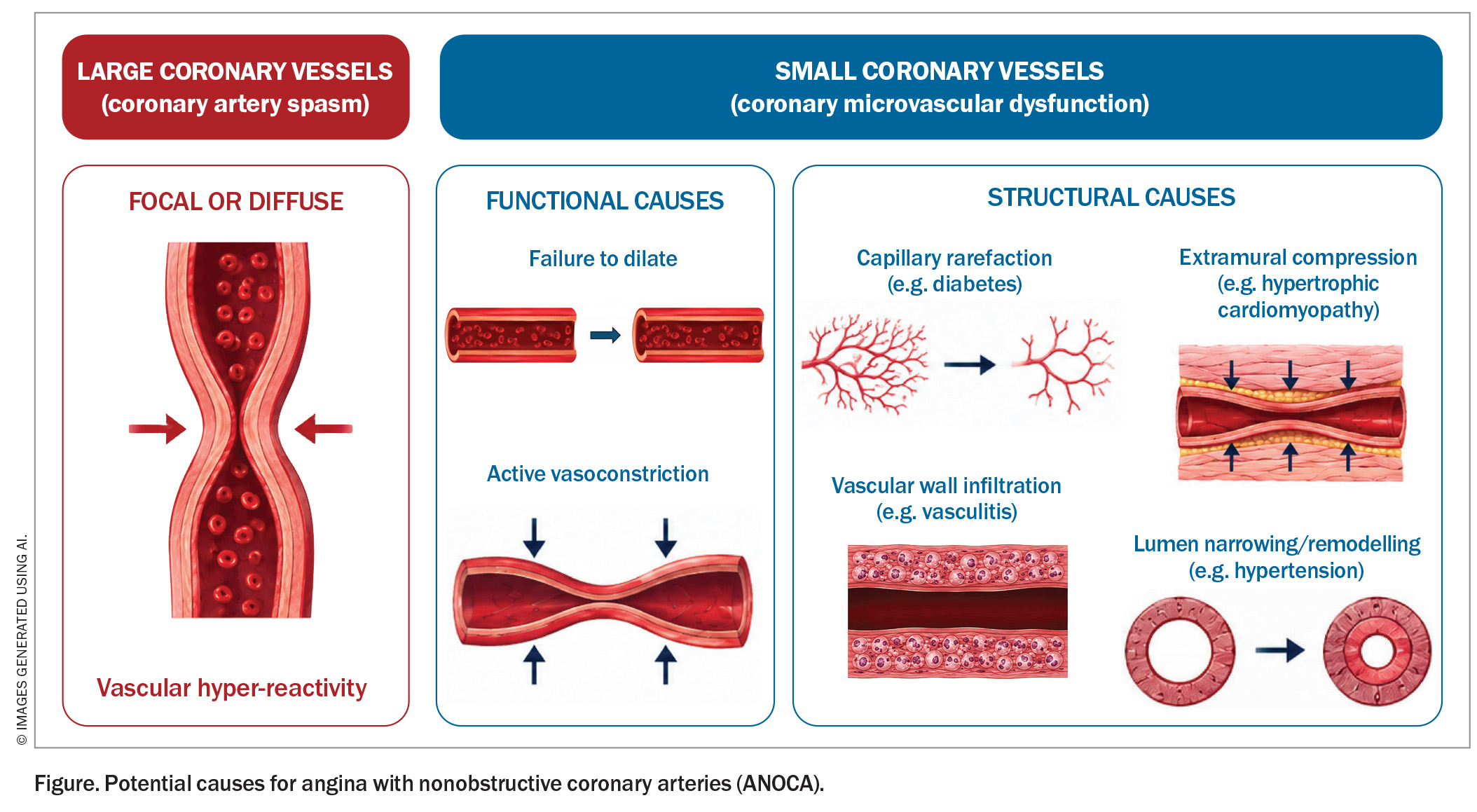
There are several causes of ANOCA, with CMD being a particularly prevalent mechanism (Figure). Microvascular angina is diagnosed in patients with ANOCA when CMD is responsible for their angina symptoms. Patients with ANOCA therefore need further investigation to confirm the presence of CMD and then targeted pathophysiological therapies to alleviate their symptoms.
Which patients develop microvascular angina?
Patients with microvascular angina are more likely to be women and are often younger than those with typical obstructive CAD. They often present with recurrent exertional chest pain resembling classical angina, despite normal coronary artery imaging. Some patients may experience angina at rest, whereas others report atypical chest pain, often erroneously labelled as noncardiac.
Importantly, microvascular angina is more common than previously thought, and GPs are likely to regularly encounter patients with this condition in clinical practice, particularly among women with persistent angina-like symptoms and normal investigations.3
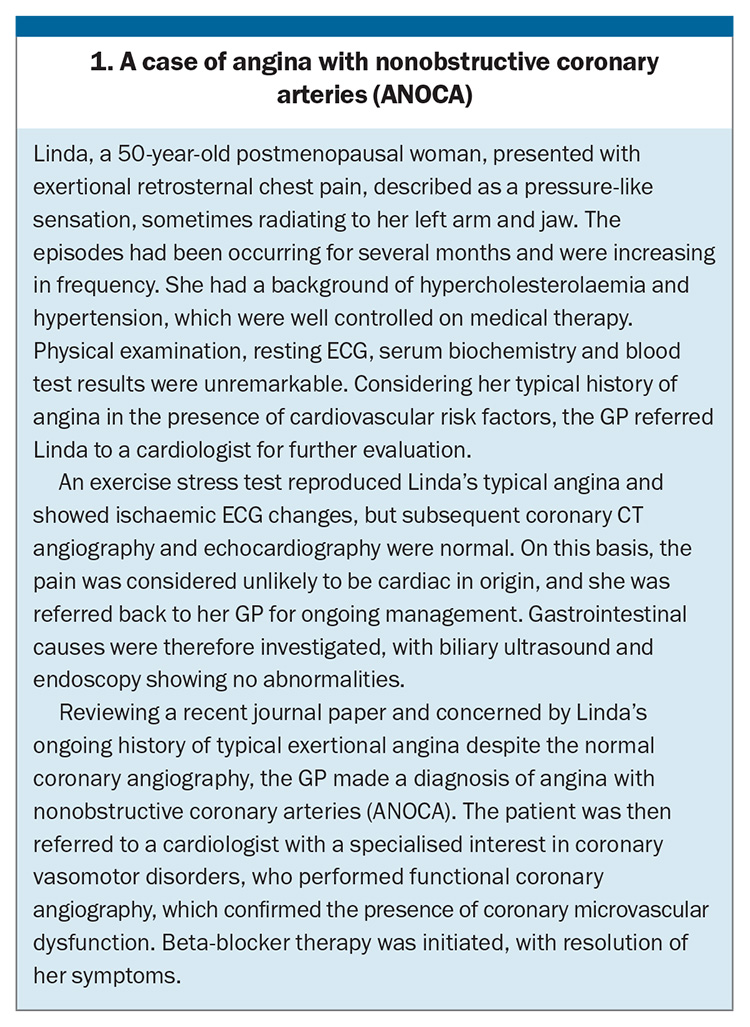
A typical clinical scenario illustrating the challenges of diagnosing microvascular angina is given in Box 1.
How are patients with ANOCA assessed?
The case study in Box 1 shows how an informed GP facilitated a correct diagnosis of microvascular angina and improved a patient’s outcome. Key questions for a GP to ask in assessing similar patients include:
- Does this sound like typical angina pain?
- Is the chest pain effort-related?
- Do sublingual nitrates improve the symptoms?
- Is there evidence of myocardial ischaemia?
Positive answers to these questions are consistent with a diagnosis of angina, for which the underlying pathophysiological mechanisms need to be determined so that appropriate therapy can be implemented. When obstructive CAD has been excluded then the ‘working diagnosis of ANOCA’ should be made and the search for underlying mechanisms continued.
How is microvascular angina diagnosed?
Functional coronary angiography: the diagnostic gold standard
Functional coronary angiography is a specialised technique undertaken via invasive coronary angiography and is the gold standard for diagnosing microvascular angina. It involves identifying the underlying coronary pathophysiological mechanisms of ANOCA by assessing:
- the presence of coronary artery spasm provoked by intracoronary acetylcholine
- CMD by measuring changes in coronary blood flow in response to a potent microvessel vasodilator (adenosine).
In microvascular angina, the microvessels do not adequately dilate to the adenosine stimulus, as reflected by an impaired increase in coronary blood flow. Noninvasive techniques such as stress positron emission tomography (PET) or stress cardiac magnetic resonance imaging (cardiac MRI) can be used to measure myocardial perfusion flow to assess CMD but these are seldom used in Australia due to limited availability and cost. Moreover, only functional coronary angiography evaluates the presence of coronary artery spasm and thus determines if the pathology lies in the large coronary arteries, microscopic coronary vessels, or both, thereby influencing the therapeutic approach.4-6
What lies behind the symptoms?
Identifying the underlying mechanism causing angina is paramount because it allows treatment to be tailored to the patient. For example, calcium channel blockers are first-line therapy for coronary artery spasm and can be used for CMD. Beta blockers are effective in CMD, whereas they are relatively contraindicated for coronary artery spasm. For this reason, understanding the specific cause for the symptoms is particularly important when initial empirical therapy does not work. In addition, distinguishing between these different causes may have prognostic implications, although further studies are needed. Importantly, establishing the correct diagnosis is not only relevant for guiding treatment, but also for improving symptom control, reducing uncertainty and, ultimately, enhancing patients’ quality of life.
What is the prognosis for patients with ANOCA?
Compared with patients with stable obstructive CAD, those with ANOCA are at less risk of major adverse cardiac events, including death, myocardial infarction or heart failure. Whether they are at increased risk of these events compared with a healthy population is less clear since some studies suggest an increased risk of cardiac events whereas others report that there is no increased risk.7,8 Regardless of these statistical cohort studies, there are multiple case reports of patients with ANOCA having experienced major cardiac events, including malignant arrhythmias, myocardial infarction and heart failure. Accordingly, patients’ risk of these ischaemic events should be acknowledged.
The major issue for patients with ANOCA is their disabling recurrent angina symptoms. Their management is difficult as:
- medical support is variable, with some clinicians dismissing their symptoms as ‘noncardiac’9
- limited evidence-based therapies are available
- symptoms impact on social relationships, employment and other activities.10
These issues need to be addressed in managing this debilitating condition.
When should I refer patients to a cardiologist?
Once ANOCA is suspected or diagnosed by the GP, referral to a cardiologist is appropriate for patients with ongoing or worsening angina. Although GPs may initiate standard antianginal therapy, persistent symptoms should prompt referral for functional coronary angiography, as this helps guide more targeted treatment.
Functional coronary angiography is available throughout Australia, although it is limited to specialised centres and is not yet routinely undertaken by most investigational cardiologists. As a result, access to this test may be limited for some patients.11 While awaiting this investigation, cardiologists may undertake empirical trials of different antianginal agents, based on the patient’s clinical presentation.
How do I treat patients with microvascular angina?
Even when a diagnosis of microvascular angina is established, management can be difficult and needs to be holistic, with the GP having a central role.
First, it is helpful to remember that a patient’s symptoms may have been previously dismissed or labelled as noncardiac in origin despite having documented CMD. Support may need to extend to social, psychological and employment issues. Additional supportive measures may be found in patient-initiated online support groups, such as the International Heart Spasms Alliance (www.internationalheartspasmsalliance.org/).
Second, antianginal medication needs to be initiated and may involve conventional or unconventional antianginal agents.
Third, cardioprotective therapies (i.e. lipid-lowering agents) should be considered, based on individual cardiovascular risk factors and the presence of atherosclerotic disease on angiography.
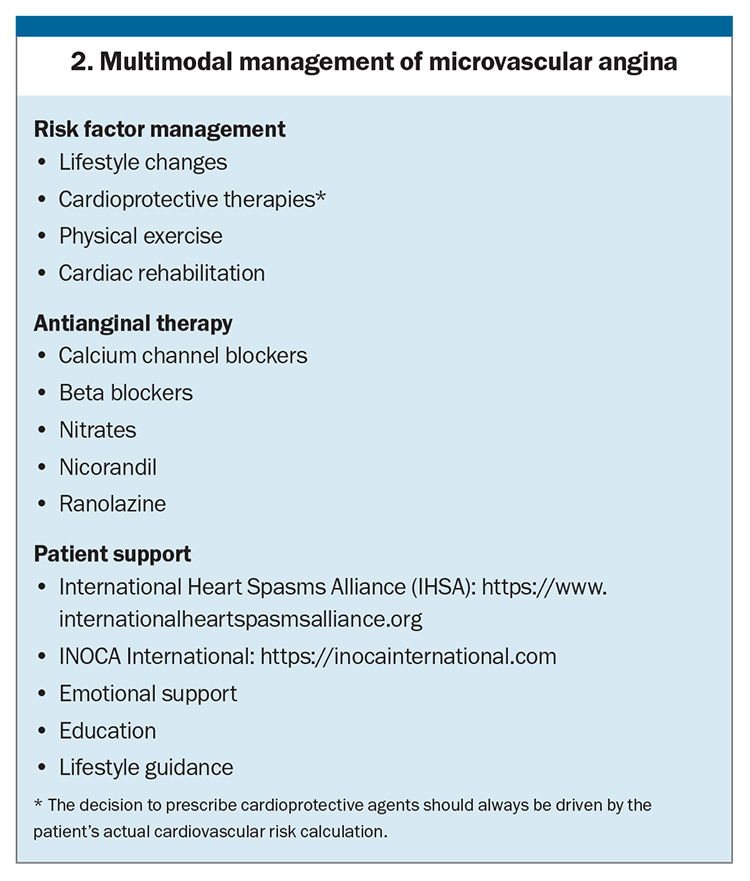
These key components of microvascular angina management are summarised in Box 2.
Where to next?
As described above, microvascular angina represents ‘big trouble from tiny vessels’. The inability to directly image the coronary microvasculature and the need to assess coronary blood flow to identify microvascular dysfunction make the diagnosis of microvascular angina particularly challenging. Ongoing studies aimed at improving diagnostic methods may eventually simplify this process, but for now functional coronary angiography remains the gold standard investigation.
Conclusion
Microvascular angina is a common but often overlooked cause of persistent chest pain in patients, particularly women, with normal coronary arteries. Although the long-term cardiovascular prognosis is generally favourable, the burden of symptoms and impact on quality of life can be substantial. Early recognition of ANOCA in general practice, appropriate reassurance and timely referral for specialist assessment when symptoms persist are key to achieving effective, mechanism-targeted treatment and improving patient outcomes.
Ultimately, the most important message is to listen carefully to the patient and consider whether they may still have angina despite having a normal coronary angiogram, prompting a diagnosis of ANOCA. This simple clinical step can be life-changing for patients, as the case study shows. CT
COMPETING INTERESTS. None.
References
1. Likoff W, Segal BL, Kasparian H. Paradox of normal selective coronary arteriograms in patients considered to have unmistakable coronary heart disease. N Engl J Med 1967; 276: 1063-1066.
2. La S, Tavella R, Wu J, et al. The patient journey in chronic coronary syndromes with/without obstructive coronary arteries. Eur Heart J Qual Care Clin Outcomes 2025; 11: 806-815.
3. Mileva N, Nagumo S, Mizukami T, et al. Prevalence of coronary microvascular disease and coronary vasospasm in patients with nonobstructive coronary artery disease: systematic review and meta-analysis. J Am Heart Assoc 2022; 11: e023207.
4. Beltrame JF, Crea F, Kaski JC, et al. International standardization of diagnostic criteria for vasospastic angina. Eur Heart J 2017; 38: 2565-2568.
5. Ong P, Camici PG, Beltrame JF, et al. International standardization of diagnostic criteria for microvascular angina. Int J Cardiol 2018; 250: 16-20.
6. Beltrame JF, Tavella R, Zeitz CJ. Beyond structural angiography. J Am Coll Cardiol 2022; 79: 2379-2382.
7. Jespersen L, Hvelplund A, Abildstrøm SJ, et al. Stable angina pectoris with no obstructive coronary artery disease is associated with increased risks of major adverse cardiovascular events. Eur Heart J 2012; 33: 734-744.
8. Olesen KKW, Madsen M, Würtz M, et al. 15-year cardiovascular risk in patients with angina without obstructive coronary arteries. JACC Cardiovasc Interv 2025; 18: 3009-3020.
9. Gulati M, Khan N, George M, et al. Ischemia with no obstructive coronary artery disease (INOCA): a patient self-report quality of life survey from INOCA international. Int J Cardiol 2023; 371: 28-39.
10. Humphreys H, Paddock D, Brown S, et al. Living with myocardial ischaemia and no obstructive coronary arteries: a qualitative study. Open Heart 2024; 11: e002569.
11. Ford T, Zeitz C, Spiro J, et al, on behalf of the CSANZ Coronary Vasomotor Dysfunction Working Group. Functional coronary angiography for the diagnosis of coronary vasomotor disorders. Heart Lung Circ 2025; 34: e89-e103.